The client challenge
The end client is a joint services holiday centre located on Île des Pins, off the coast of New Caledonia — an isolated island environment with no connection to the mainland drinking water network.
The military base needed an autonomous drinking water source, compliant with Drinking Water Standards (DWS), from the only resource available on site: seawater.
The constraints were multiple:
- Producing drinking water to DWS regulatory quality from seawater
- Integrating into a constrained space on an isolated site with no existing treatment infrastructure
- Rapid deployment with no delay in operational commissioning
- Ensuring a high level of reliability and operational autonomy
- Integrating pre-treatment, desalination and clean-in-place functions into a compact, transportable system
The Projects Division of the Defence Infrastructure Directorate in Nouméa entrusted Nomado with the design and construction of a compact skid-mounted desalination unit.
The Nomado solution
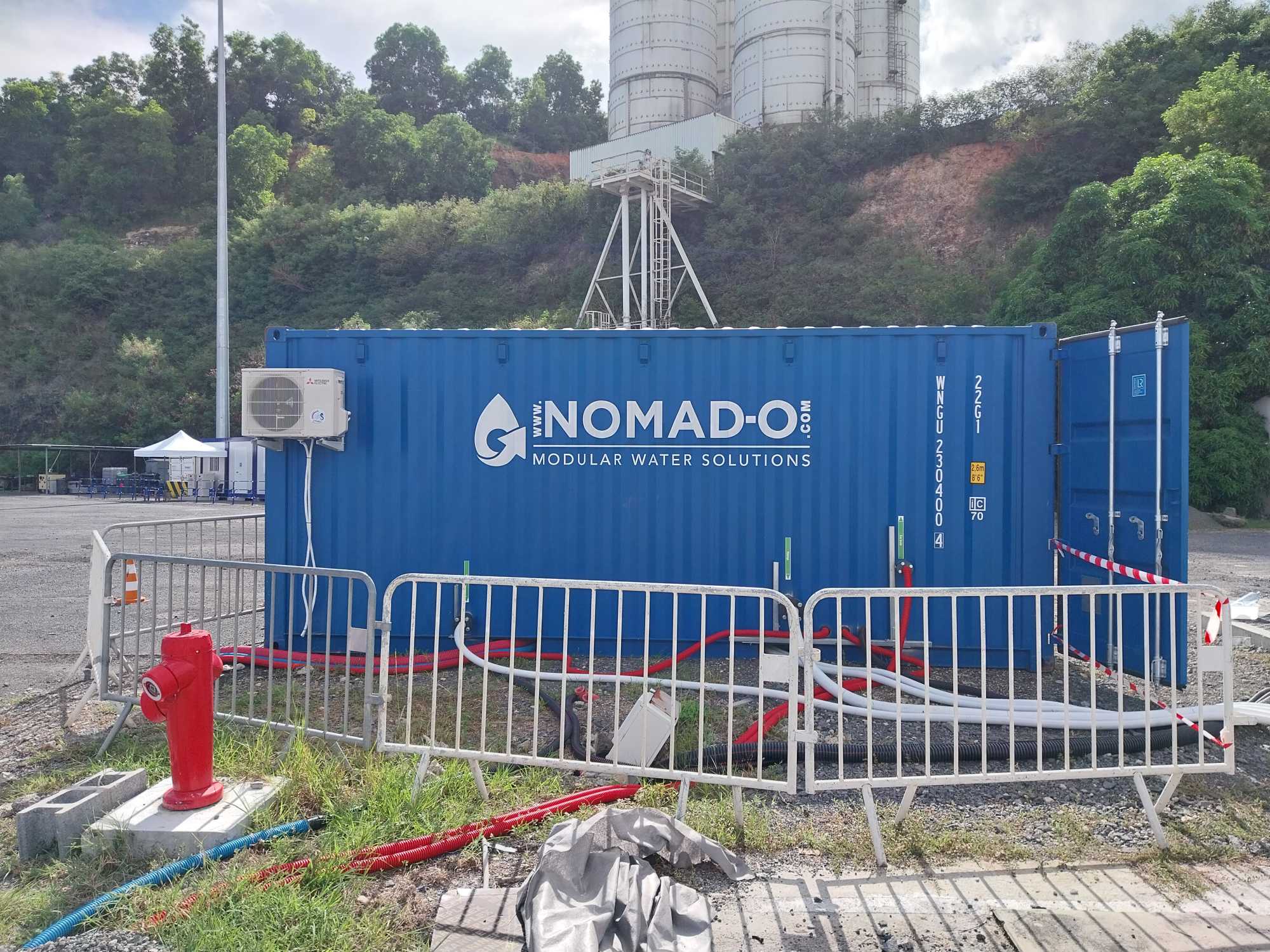
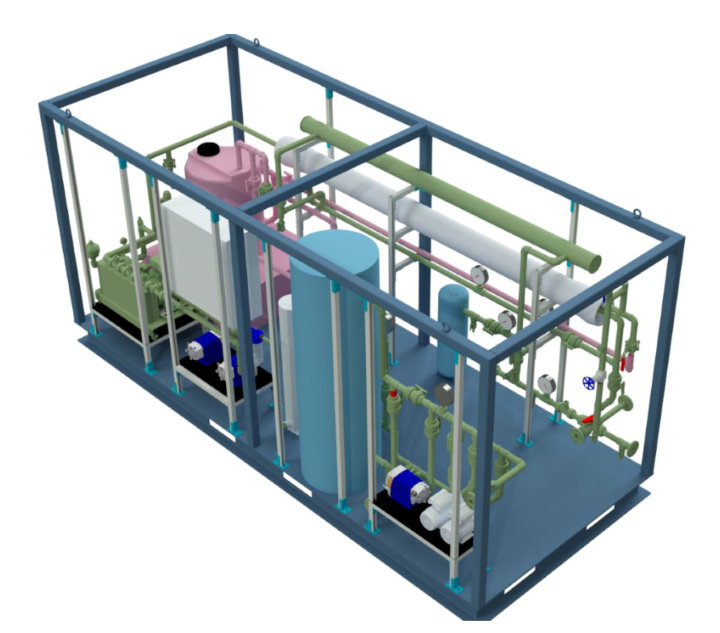
Nomado designed and built a high-pressure reverse osmosis seawater desalination skid, integrating the full treatment chain — from pre-treatment to remineralisation — on a compact welded steel skid, transportable by sea.
Our approach combined process industrialisation, high-quality water production and ease of operation in an isolated setting.
A complete process on a single skid
The unit produces 1.5 m³/h of drinking water compliant with DWS standards from a 5 m³/h feed flow of raw seawater, through the following treatment chain:
Pre-treatment
- 2 feed pumps: controlled supply to the process
- Dual-media sand filter: removal of suspended solids and turbidity
- Microfiltration: protection of the reverse osmosis membranes
Desalination by reverse osmosis
- High-pressure pump (60 bar): pressurisation of water for passage through the membranes
- Reverse osmosis membranes: removal of salt and dissolved ions to achieve DWS quality
Post-treatment and remineralisation
- Remineralisation: pH correction and mineral addition for organoleptic and regulatory DWS compliance
Maintenance and monitoring
- CIP (Clean-In-Place) circuit with tank and reagent injection: autonomous membrane cleaning without disassembly
- Full instrumentation for measurement and control: continuous supervision of process parameters
- Control panel: centralised operation of the entire unit
Turnkey deployment on an isolated site
Engineering and design
- Full design study (hydraulic and mechanical sizing)
- Integration of all equipment on a compact welded steel skid
Results achieved
- Production of 1.5 m³/h of drinking water compliant with DWS standards
- Compact unit, fully integrated on a skid, shippable by sea to an isolated island site
- Controlled conversion rate: 5 m³/h feed for 1.5 m³/h produced
- Autonomous operation facilitated by the integrated CIP circuit and full automation
- Commissioning completed on schedule, on a site with no pre-existing treatment infrastructure