Introduction
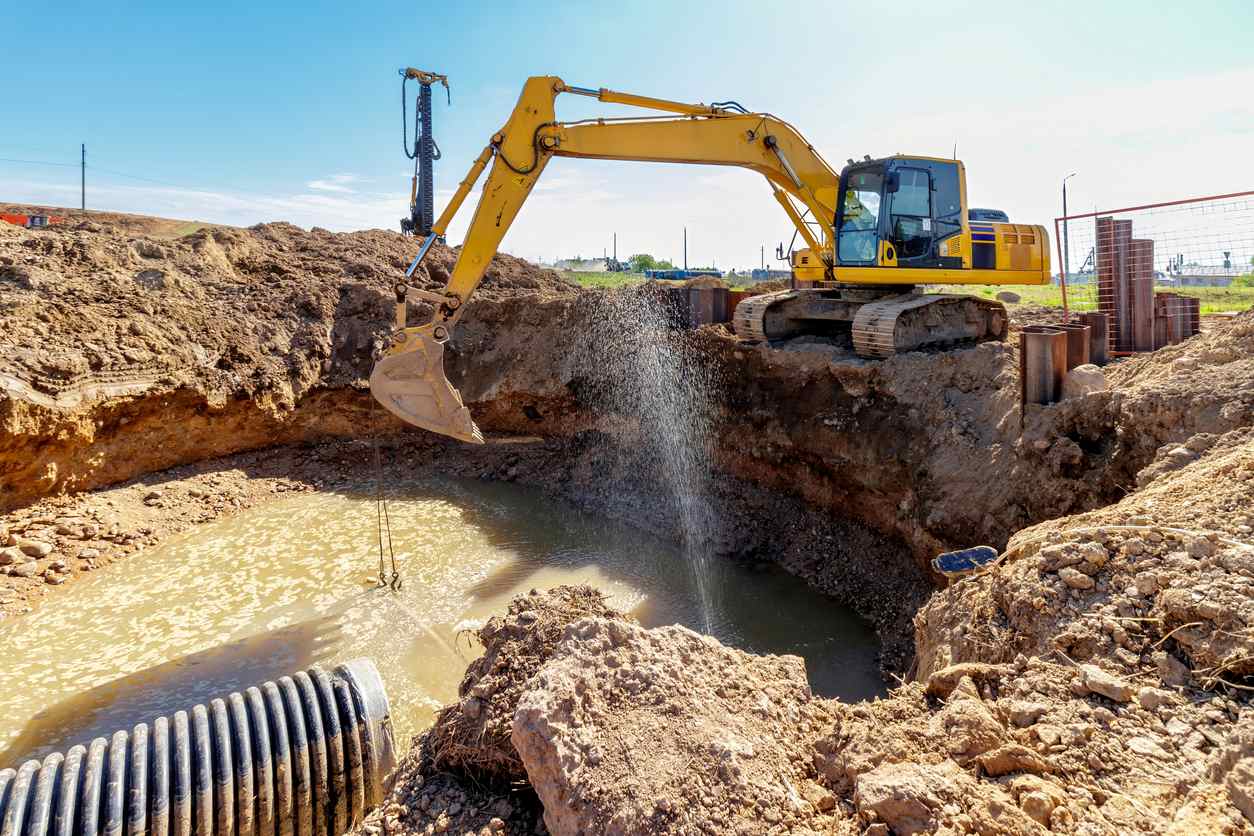
On a construction site, water is everywhere. It surges from boreholes during earthworks, accumulates in excavations after rain, becomes loaded with cement during concreting, coloured by machine oil, cloudy with clay fines after machinery passes. For a long time, this water was managed carelessly. Regulatory changes, growing environmental awareness and more frequent inspections have transformed the situation. Today, construction site water treatment is no longer optional — it is an obligation.
I. The different categories of construction site water
Dewatering water: groundwater infiltrating excavations (foundation pits, trenches, tunnels). Volumes range from tens to several hundred m³/h.
TBM and drilling rig water: bentonite or polymer slurry returns loaded with mineral fines, clay and polymers.
Cement laitance: highly alkaline effluents (pH >12) from concrete pouring, aggressive to aquatic environments.
Site runoff: rainwater loaded with particles, mud and sometimes hydrocarbons.
Base camp wastewater: domestic wastewater from camps housing dozens to thousands of workers, often not connected to the public network.
II. The regulatory framework
Construction site water treatment falls under France’s Water Act and IOTA regulations. Depending on volumes and discharge characteristics, sites are subject to declaration or authorisation by DDT/DREAL authorities. The key texts are the French Environmental Code (articles L.214-1 to L.214-6 and the IOTA nomenclature in article R.214-1, notably headings 1.1.2.0 for dewatering abstraction, 2.1.5.0 for stormwater discharge and 2.2.1.0 and 2.2.3.0 for discharges to surface water), article L.1331-10 of the Public Health Code for any non-domestic discharge to the public sewer, and the Order of 21 July 2015, which replaced the Order of 22 June 2007, for base camp wastewater treated on site above 20 PE. Key monitored parameters: TSS (often ≤35 mg/L), pH (6.5–8.5), total hydrocarbons (<5 mg/L), BOD5 and COD for base camp wastewater.
Non-compliant discharge exposes the company to enforcement orders, administrative fines, criminal prosecution and reputational damage.
III. Mobile and modular solutions
Construction site water treatment has its own specificities: temporality, variability, mobility on linear sites, and space constraints. Fixed permanent industrial solutions are unsuitable.
For fine-laden water (dewatering, TBMs): lamellar settling, DAF, sand/cartridge filtration, filter presses.
For cement laitance: CO₂ neutralisation (cleanest, most controllable), or acid dosing (less recommended).
For hydrocarbons: gravity oil separators, coalescers, polishing activated carbon.
For base camp wastewater: compact MBR, septic tank + sand filter, compact activated sludge plants.
Nomado units are delivered plug-and-play on standard lorries: standardised electrical connections, identified hydraulic connections, integrated control PLC.
IV. Nomado’s field expertise
Nomado was built on construction sites, particularly underground works (tunnels, galleries, shafts). Our portfolio covers railway and road tunnels, urban earthworks, linear projects and major site camps.
The WaaS model is particularly suited to construction: zero equipment investment, no team training, no maintenance management. Nomado provides the turnkey solution, guarantees performance, and recovers the unit at project end.
V. Best practices
Integrate water treatment from the tender response stage. Train site teams. Implement regular discharge monitoring for compliance verification and inspection traceability.
Conclusion
The solutions exist, are proven, mobile and adapted to field reality. Because a well-managed construction site is also one where water is under control.
FAQ
1. When must water treatment be implemented? As soon as site-produced water does not meet regulatory discharge criteria.
2. How long does deployment take? 3 to 8 weeks for standard units depending on complexity.
3. What to do with treatment sludge? Managed under waste regulations — valorised in quarries or eliminated at an approved centre.
4. Is WaaS suitable for a short project (6 months)? Yes — one of the most compelling use cases.
5. Can Nomado intervene urgently on a non-compliant site? Yes. Contact us as quickly as possible.